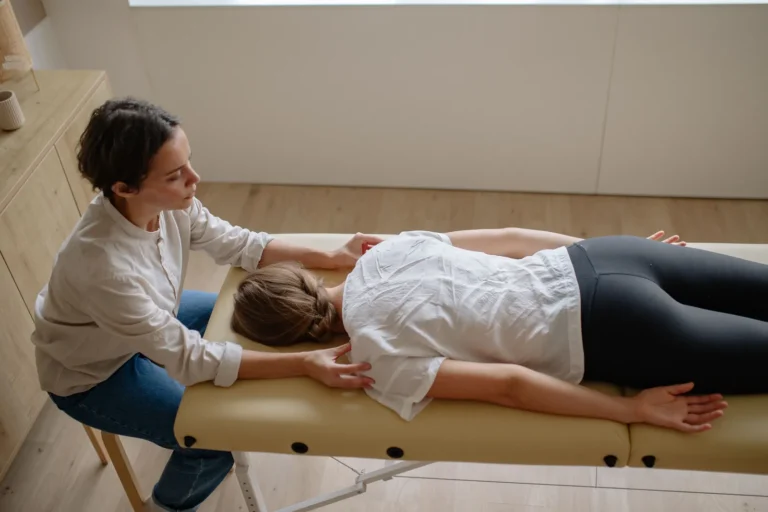
A pinched nerve in your neck means something is pressing on or irritating a nerve root near your spine. As a result, you may feel pain, tingling or numbness that runs down one arm. It can feel scary, especially when your hand starts to buzz for no clear reason. The good news is that most cases get better within weeks to a few months with time and simple, nonsurgical care. Below, we explain the signs, the causes, how long it lasts and when to get help fast.

What a pinched nerve in your neck feels like
Doctors call this problem cervical radiculopathy. Cervical means the neck, and radiculopathy means a problem with a nerve root. These roots branch off the spinal cord through small openings between the bones of your neck.
Common signs include:
- Sharp or burning pain that spreads from the neck into the shoulder or arm
- Tingling or a pins and needles feeling in the arm, hand or fingers
- Numbness in part of the arm or hand
- Weakness in the muscles of the arm, shoulder or hand
- Weaker reflexes, which a provider can check during an exam
Symptoms usually affect one side only. Certain moves may make the pain worse, for example tipping your head back or straining your neck.
Some people notice that resting a hand on top of the head eases the arm pain for a while. That position may take a little pressure off the irritated nerve root.
Why your arm tingles when the problem is in your neck
Each nerve root in your neck serves its own area of the shoulder, arm and hand. The pressure sits near the spine, yet you feel it along the whole path of that nerve. That is why your arm or hand can tingle even when the arm itself is not injured.
What causes a pinched nerve in the neck?
Most cases come from normal wear and tear in the spine, which doctors call cervical spondylosis. Over the years, the discs between your neck bones lose height and stiffen. Your body then forms extra bone, called bone spurs, around the worn discs. In turn, those spurs can narrow the openings where the nerve roots exit.
A herniated disc is the other main cause. Here, the soft center of a disc pushes through a crack in its tougher outer layer. That material can then press on a nearby nerve. This cause is more common in people up to about age 50, and lifting, twisting or a neck injury can play a part.
Still, disc wear by itself is no reason to panic. It is a normal part of aging, and many people have it without any pain. After a car accident, though, neck symptoms do not always start right away. Our guide to delayed whiplash symptoms explains what to watch for.
Is it your neck or your wrist?
Hand tingling does not always start in the neck. Pressure on a nerve at the elbow or the wrist can cause similar symptoms, as with carpal tunnel syndrome. Other nerve problems, such as neuropathy, can also cause numbness.
A few clues point toward the neck. For instance, the pain often starts in the neck and then spreads down the arm. An exam helps sort this out, because a provider checks your neck, shoulder, arm and hand on both sides. If the wrist looks like the main source, see how we care for carpal tunnel syndrome.
How long does a pinched nerve in the neck last?
For most people, it is a short-term problem. Cleveland Clinic reports that most cases get better within eight to 12 weeks, often without any specific treatment. In other words, a pinched nerve in the neck usually improves without surgery. However, symptoms return in up to one in three people after they first improve. If yours return, that is a good time to get checked.
When should you call a provider? Cleveland Clinic suggests it when arm pain from your neck does not ease after a week or more of rest. Surgery may come up as an option if nonsurgical care has not helped after six to 12 weeks, or if nerve symptoms are severe or getting worse.
Self-care for a pinched nerve in your neck
Small daily changes may ease the strain while it settles. These ideas come from Cleveland Clinic advice on neck pain:
- Use heat or cold for about 15 minutes at a time, and choose cold right after an injury.
- Raise your screen so you do not slouch or crane your head forward.
- Take short breaks from sitting to move around.
- Sleep with a pillow that keeps your head in line with your body, and skip stomach sleeping with your head turned.
- Carry heavy bags in your hand or on wheels, not over one shoulder.
Be careful with stretches, though. Cleveland Clinic advises against trying neck exercises on your own when you have a pinched nerve, so ask a provider first. Also, stop any move that sends pain further down your arm.
Neck trouble can show up as head pain, too. If yours starts low at the back of your head, read about headaches at the base of the skull. Not sure what kind you have? Our guide to tension headache versus migraine can help.
Can a chiropractor help a pinched nerve in the neck?
Chiropractic care may help some people with neck pain, especially as part of a plan that includes exercise. According to the National Center for Complementary and Integrative Health, spinal manipulation can be helpful for acute neck pain. For long-lasting neck pain, manipulation or gentler mobilization may reduce pain and improve function. Even so, the quality of that evidence is low to moderate. Also, these reviews focused on neck pain in general, not pinched nerves alone.
Mild soreness, stiffness or a headache is common after an adjustment, and it usually fades within a day. Serious problems are rare. Researchers have linked neck manipulation to rare tears in the arteries of the neck, which can lead to a stroke. However, experts disagree about whether manipulation actually causes these tears.
You can always ask questions or say no to any part of care. If you would rather skip neck adjustments, just tell us. Your plan can lean on soft tissue work and exercise instead.
When to see a doctor or go to the ER
Most pinched nerves are not emergencies. Even so, some signs need fast care. Call 911 if arm pain comes with chest pain or pressure, shortness of breath, sweating or pain spreading to the jaw. These can be signs of a heart attack. A headache with fever and a stiff neck also needs the ER.
Get urgent medical care if your neck pain:
- Started after a car accident, fall or other injury
- Comes with loss of bladder or bowel control
- Brings weakness in your legs or trouble with coordination in your arms or legs
- Shows up with a headache, dizziness, nausea or vomiting
- Occurs with fever, chills or weight loss you cannot explain
- Hurts just as much when you rest as when you move
In addition, call a provider as soon as possible if the muscles in your arm, shoulder or hand feel weak.
How we approach it at HealthSource of Roseland
At HealthSource of Roseland, Dr. Jenna Patel, D.C., evaluates you before any care starts. First, you fill out a health history and talk with her about your symptoms. Next, she does a physical exam that looks at your posture, mobility and pain. We take X-rays on site only when they are clinically needed. Then she explains what she found and walks you through a personalized care plan.
Dr. Patel looks for the source of the problem, not only the symptoms. Your plan may include hands-on adjustments, soft tissue work and exercise rehab, plus sleep and lifestyle habits that take strain off your neck. Care may help ease pain and improve how you move, but results vary. She rechecks your progress along the way, and if you are not improving, we change course.
Dr. Patel speaks English, Hindi and Gujarati, so you can ask questions in the language you prefer. You can also learn more about our neck pain care in Roseland.
A calm next step
If arm tingling or neck pain has lasted more than a week, or it keeps coming back, you do not have to guess. Book a visit online or call (973) 200-2424. Ask about our new-patient visit: consultation, exam and X-rays if clinically needed. Our new-patient offer is for new patients only. It does not apply to Medicare, Medicaid, other federal healthcare program patients or ACN members.
This article is for education only and is not a diagnosis. If you have any of the red flags above, please see a medical doctor or go to the ER.