The honest answer is that spinal decompression for stenosis has not been studied well enough to know if it helps. A spine care guideline found too little evidence to recommend for or against traction for lumbar stenosis. Care that pairs hands-on work with exercise has stronger, though still moderate, support. Still, decompression is gentle, non-surgical and done while you stay clothed. So if a bulging disc adds to your leg pain, it may be worth talking about as one part of a wider plan.
Below, we explain what stenosis is, how the table works and what the research says. We also cover who should skip it and how Dr. Jenna Patel, D.C., decides what fits you. This article is for education only and is not a diagnosis.

What spinal stenosis is and why it hurts
Spinal stenosis means the spaces inside your spine have narrowed. That narrowing can press on the spinal cord or on the nerve roots that branch off it. According to the NIH overview of spinal stenosis, it shows up most often in the lower back and neck. It usually develops slowly, and the chances of getting it go up with age.
Several things can crowd the space. For example, ligaments can thicken, bone spurs can form and a disc can bulge. Arthritis is also a common cause. In the lower back, stenosis may cause a burning ache that spreads into the buttocks and legs. You may also feel numbness, tingling, cramping or weakness in the legs and feet.
Many people notice a clear pattern. Standing and walking tend to make the leg symptoms worse. In contrast, sitting or leaning forward may ease them.
How non-surgical spinal decompression works
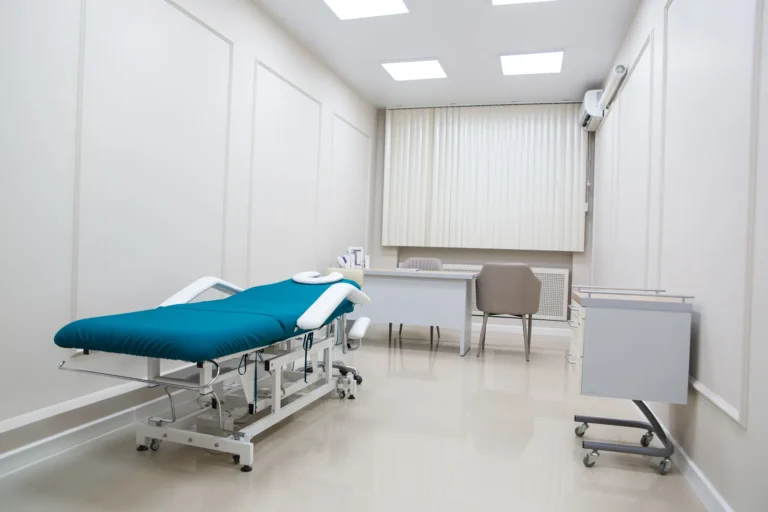
Non-surgical decompression is motorized, computer-controlled traction. You stay fully clothed and lie on the table. Harnesses go around your pelvis and trunk. Then the table gently pulls and relaxes in cycles.
The goal is to ease pressure on the discs and nerve roots. However, how it works inside the body is still a theory. It is also different from surgical decompression, which removes bone or disc tissue to make more room. A table removes nothing, so there are no needles or incisions. For a sense of how plans are commonly described, see our post on how many sessions people need and how often.
What the research says about spinal decompression for stenosis
The North American Spine Society reviewed the evidence on treating lumbar spinal stenosis. Its guideline found too little evidence to recommend for or against traction. Decompression tables are a form of traction, so that same gap applies to spinal decompression for stenosis.
An updated review of non-surgical stenosis care points the same way. It found moderate-quality evidence for care that combines manual therapy with exercise. Traction did not have that kind of support for stenosis.
What about decompression for leg pain in general? Some randomized trials found short-term gains in leg pain and function for disc-related sciatica. Those trials studied disc-related leg pain, though, not stenosis. In an older trial, a decompression system did no better than a fake (sham) treatment: both groups improved, with no difference between them. Larger reviews of traction for back pain are mixed, too. Some guidelines do not recommend traction for general low back pain. We walk through those studies in our post Does Spinal Decompression Work?
Put simply, spinal decompression for stenosis is not a proven treatment, but the research has not ruled it out either. It might help some people, and no one can promise that it will help you. Also, a table does not remove bone spurs or thick ligaments, which are common causes of stenosis.
When spinal decompression for stenosis may fit your plan
Given the research, decompression makes the most sense as one piece of a plan, not the whole plan. If your exam suggests a disc is adding to the pressure on a nerve, it may be worth discussing with Dr. Patel. In that case, it would sit alongside care with stronger support, such as hands-on work and exercise rehab.
Here is what decompression offers when it does fit:
- It is non-surgical, with no needles or incisions.
- You stay fully clothed for every session.
- The table pulls gently, then relaxes, in cycles.
- Some people with disc-related leg pain may feel short-term relief when it is part of an exercise plan.
- Dr. Patel rechecks your progress and changes course if you are not improving.
Disc wear is also common as we age. If your imaging report also mentions worn discs, our post on decompression for degenerative disc explains what that changes. In short, traction is listed as something that may help for a while, not as a long-term fix.
Is spinal decompression safe with stenosis?
Decompression is not right for everyone. You should not have it if any of these apply to you:
- Pregnancy
- A spinal fracture
- Tumor
- Abdominal aortic aneurysm
- Advanced osteoporosis
- Metal implants or hardware in the spine
Dr. Patel also screens for recent spinal surgery, infection and an unstable spine. So please tell us about any past back surgery, because hardware or a recent operation can rule decompression out. If decompression is not a fit, Dr. Patel can talk through other options with you.
What about side effects? Some trials reported short-lived soreness or a brief increase in pain. Serious problems are uncommon. Even so, a Cochrane review noted that many trials did not report side effects well. That is why we watch how you respond. Tell us right away if your leg symptoms get worse during or after a session.
When to see a doctor or go to the ER
Some symptoms need medical care first, not a chiropractor. Go to the ER right away if you lose bladder or bowel control. The same goes for new numbness in the groin, buttocks or inner thighs. These can be signs of serious nerve pressure.
See a medical doctor soon if you have any of these:
- Leg weakness that keeps getting worse
- New changes in sexual function
- Fever along with back pain
- A history of cancer, or weight loss you cannot explain
- Pain that started after a fall
- Pain that wakes you up at night
Leg pain that builds as you walk and eases when you bend forward is a common stenosis pattern. It is worth a proper exam, even when the pain feels mild.
How we approach it at HealthSource of Roseland
At HealthSource Chiropractic of Roseland, Dr. Patel evaluates you before any care starts. Your first visit includes a health history, a consultation and an exam of your posture, mobility and pain. We take X-rays only if they are clinically needed. Then she explains her findings and a personalized care plan. You are welcome to ask questions before you agree to anything.
Her approach looks for the source of your problem, not only the symptoms. For stenosis, her plan may include hands-on adjustments, soft tissue work and exercise rehab. That is close to the manual therapy and exercise mix with moderate-quality support. If a disc seems to add to your nerve pain, she may also talk with you about decompression. You can read more about decompression at our office on the spinal decompression service page. For movement ideas, see our guide to exercises for stenosis.
Along the way, Dr. Patel rechecks your progress. If you are not improving, we change course. That may mean a different approach or a referral to a medical doctor.
A quick note on cost: Medicare covers chiropractic manipulation for subluxation and not other services such as decompression, so call your plan and us to check. We accept most major insurance plans. We also offer financing through Cherry and CareCredit, plus the APEX discount plan.
Your next step
If stenosis is cutting your walks short, a careful exam is a calm place to start. Ask about our new-patient visit: consultation, exam and X-rays if clinically needed. The offer is for new patients only. It does not apply to Medicare, Medicaid, other federal healthcare program patients or ACN members. When you are ready, book online or call (973) 200-2424. You can find us at 12 Eisenhower Parkway, Suite 1, in Roseland.